
by Douglas Johnson
The catastrophe of the Trump-MAGA government has created an understandable impulse: vote Democratic in the midterm elections and begin repairing the damage. While this response may unseat the Republican Party, it ignores the fact that a vote for the Democrats is not simply a vote against Trump, it is also a vote for a political party whose policies and failures over several decades helped create the economic, social and political conditions that laid the groundwork for Trump’s rise.
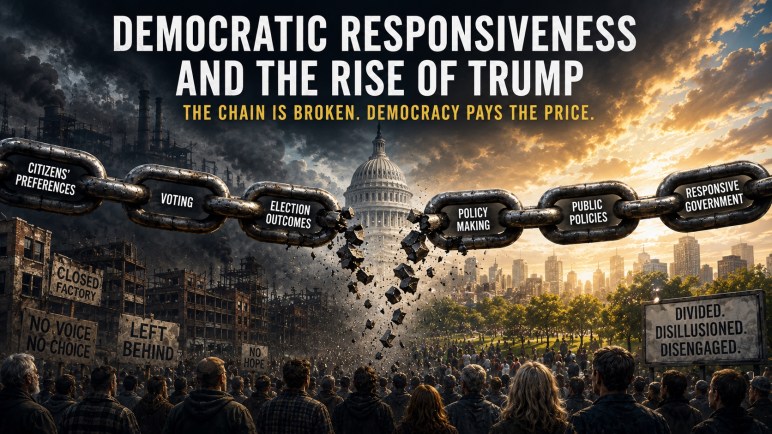
Political scientist G. Bingham Powell describes democracy as a “chain of responsiveness” connecting citizens’ preferences to government policy. Powell writes,
Democratic responsiveness is a complex process, somewhat like a chain whose links are causally connected. It begins with the policy preferences held by citizens, and moves link by causal link through such stages as voting, election outcomes, the formation of policy-making coalitions, the process of policy making between elections, and public policies themselves. The process is ongoing and dynamic: The policies that are actually adopted and the consequences that flow from them affect the future preferences of citizens (Powell, 2004, p. 91).
A break in any link means a break in democratic responsiveness. Continuous breaks signal a breakdown in democracy. The problem is not simply who wins the next election. It is whether the chain itself is functioning, and whether the Democratic Party, which repeatedly breaks this chain in fundamental ways, has the answer.
There are numerous occasions over the last few decades where Democratic politicians have explicitly supported policies that were contrary to the interests and preferences of significant portions of their electorate. These breaks have warped the economic, political and ideological landscape, which in turn has undermined the mental and physical health and wellbeing of large segments of the US population.
One of the most egregious breaks in the chain was the North American Free Trade Agreement (NAFTA), which hastened the transfer of US manufacturing overseas. Bill Clinton strongly supported NAFTA, signed it in 1993, and congressional Democrats supplied a substantial portion of the votes necessary for passage. The Democratic Party, which until then had been the party of the poor and working class, suddenly became much less responsive to the will of their constituency. NAFTA accelerated deindustrialization, which stagnated whole communities of working-class people, who began questioning their future as well as their children’s future. Most manufacturing jobs never returned, and people suffer to this day.
Shortly after passing NAFTA, the Democratic party worked with the Republicans to pass the 1996 Personal Responsibility and Work Opportunity Reconciliation Act (PRWORA), also known as welfare reform. This reduced the number of welfare recipients by almost 60% and disproportionately harmed vulnerable people, including people with disabilities. Benefits were not simply reduced. Rather, additional work requirements and time limits were imposed on welfare recipients, requirements that people with disabilities could have particular trouble meeting (Berkowitz, 2020). Essentially, this act signaled that the Democrats’ New Deal concept of unconditional responsibility toward economically vulnerable citizens was over.
Following this, the Democratic Party helped transform the information environment by passing the 1996 Telecommunications Act, which facilitated the massive consolidation of independent local media into a handful of corporate owners. Within 10 years, the top four firms controlled more than 60% of the market in each of the telecommunication industries, and one company owned 1,200 radio stations (Atkin et al., 2006). Journalism increasingly changed from a local public service into a centralized for-profit commodity. Corporate news outlets curtailed their role as government watchdogs, and instead became content factories that, by sheer domination of the airwaves, produce political spectacles that discourage divergent views and shape how people think. As democracy depends on an informed electorate, this break is more like a rupture.
In the following decade, with bipartisan support from Republicans, the Democrats joined in passing the 2008 FISA Amendments Act, which expanded government surveillance of Americans. This not only normalized government spying that persists even today, but gave retroactive immunity to telecommunications companies that participated in warrantless surveillance.
Perhaps the weakest link in the Democrats’ causal chain is their repeated participation in bipartisan military interventions, amounting to almost perpetual war. The Democrats gave strong bipartisan support for the 2001 Authorization for Use of Military Force (AUMF), which vaguely set their sights on the “9/11 perpetrators and those who harbored them,” and later added the nebulous “associated forces of al-Qaeda.” The 2001 AUMF remains in force today and has been passed down and invoked by every president since its inception. Voter preferences have been ignored throughout.
Military support for Israel, a primary instigator of war in West Asia, is predominantly bipartisan. One military conflict that the Democrats opposed was Trump’s military campaign against the Houthis in Yemen, although the Democrats had supported the Saudi-led war in Yemen. Another war they now oppose is Trump’s war against Iran. It begs the question whether Democratic resistance to Trump’s Iran war is principled or political. Regardless, permanent war has become normalized due in no small part to the Democrats.
The damage inside the US from the last 30 years is almost incalculable. Within the torn and fragmented neighborhoods across the US, people find they have no voice. They have scant access to reliable news or civic organizations that can represent their interests. They have little means of changing their circumstances, and inadequate government assistance. Pluralism, upon which democracy depends, has been severely weakened. Understandably, many feel polarized, disillusioned, and harbor deep anti-establishment feelings. These are precisely the sentiments that Trump capitalized on in his run for the presidency.
To say that Trump is a problem that only Democrats can fix, is like saying cancer is a problem that only carcinogens can fix. Trump is, by far, the worst president in US history. But the idea that we can restore democracy by removing the bad people and installing better people is false. The election is only one link in a much longer chain. The problem is systemic. The system delivered Trump. Until democratic responsiveness is restored, expect another demagogue very soon.
ABOUT DOUGLAS JOHNSON
I’ve taught English in Palestine, Iraq, and Oman. I currently reside in Indonesia, but my heart will always be in Louisville, Kentucky.
References
Atkin, D. J., Lau, T.-Y., & Lin, C. A. (2006). Still on hold? A retrospective analysis of competitive implications of the Telecommunication Act of 1996, on its 10th year anniversary. Telecommunications Policy, 30(2), 80–95. https://doi.org/10.1016/j.telpol.2005.05.008
Berkowitz, E. D. (2020). Clinton, Gingrich, and welfare reform in 1996. In Making social welfare policy in America: Three case studies since 1950 (pp. 221–261). University of Chicago Press. https://doi.org/10.7208/chicago/9780226692371.003.0008
Powell, G. B. (2004). The quality of democracy: The chain of responsiveness. Journal of Democracy, 15(4), 91–105.
https://doi.org/10.1353/jod.2004.0070
NOTE: Louisville-FOR encourages submissions of independent content and opinion. This article represents the views of the author who retains copyright of the material published.

