by Douglas Johnson
On July 4, 2026, on the US’ 250th birthday, former president Bill Clinton gave an address on the state of the US and its enduring democracy. He wrote:
“Two hundred and fifty years ago in Philadelphia, our Founders embarked on a radical experiment and declared a new nation rooted in the ideal of equality, with an elected government charged to advance life, liberty, and the pursuit of happiness. Since then, our government of, by, and for the people has become the longest-lasting continuous democracy in the history of the world” (Clinton, 2026).
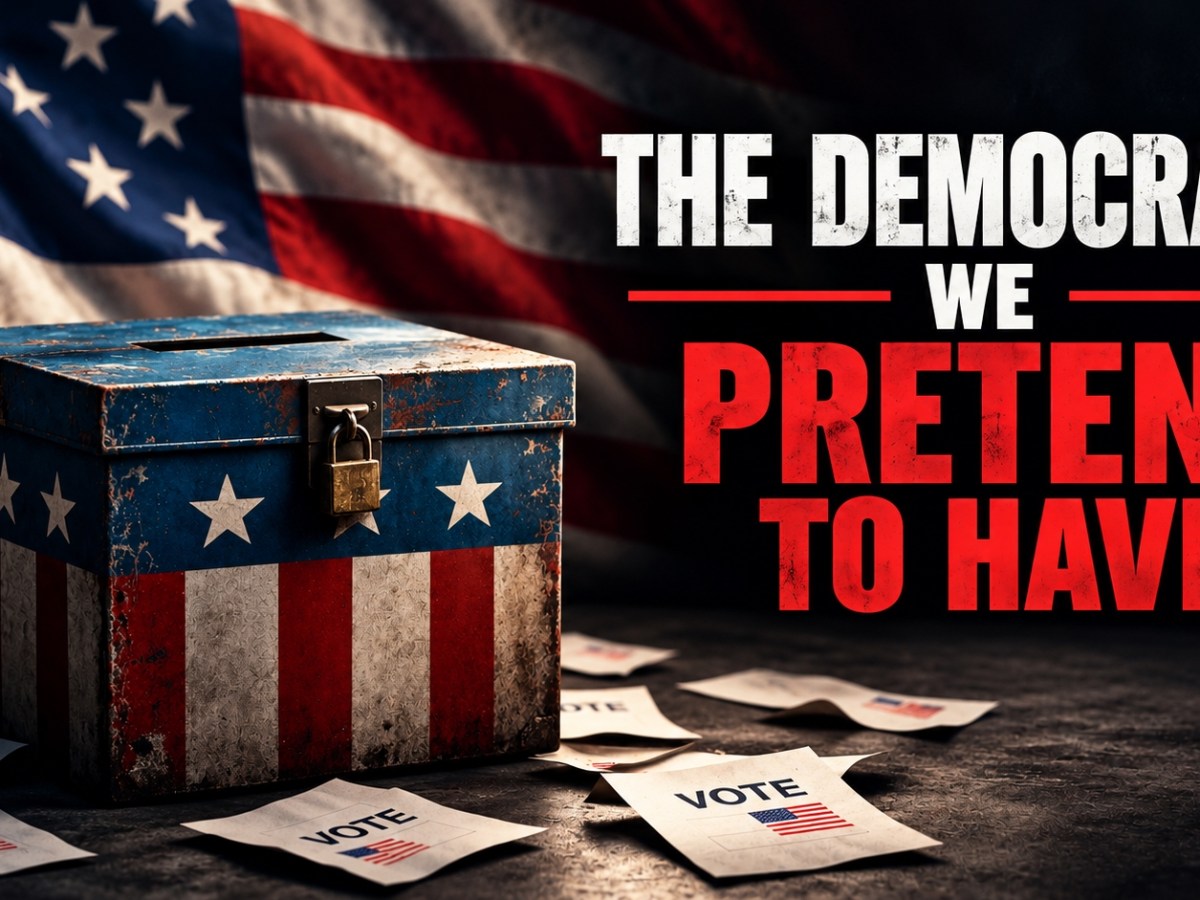
While it’s true that the “ideal of equality” is the heart of any true democracy, the idea that the US government is of, by, and for the people, or that US democracy is still alive and well, is – as I will argue – dubious, as it fails to ensure political equality. While formal democratic institutions still exist, and the US pays homage to the façade of electoral politics, power no longer resides with the people (Wolin, 2008).
Robert A. Dahl, in his book “On Political Equality,” argues that citizens in an ideal democracy enjoy effective participation, equality in voting, enlightened understanding, and final control of the agenda. Without these criteria of political equality, democracy withers. The problem is that while the right to vote in the US still exists, the political effectiveness of that vote is profoundly unequal (2006). On the other hand, the financial elite, who greatly influence most, if not all, democratic institutions, have substantially greater capacity to influence politicians, organize campaigns, obtain information, lobby government, and participate in political organizations.
The elite exert direct influence through lobbying and campaign finance. Nearly $37 billion was spent on federal lobbying between 2015–2024, $4.4 billion in 2024 alone (Scholtens, 2025). To finance their political campaigns during 2023-24, presidential candidates raised $2.0 billion, congressional candidates raised $3.8 billion, political parties raised $2.7 billion, and PACs raised $15.7 billion (FEC, 2025). Additionally, in 2024, 2,502 super-PACs raised $5.1 billion (OpenSecrets, 2025). Miriam Adelson, who helped persuade Trump to move the US embassy to Jerusalem in 2018, contributed $100 million to Preserve America, a super PAC supporting Trump in 2024 (Elia-Shalev, 2024).
Not surprising, OpenSecrets (2022) reports that historically, candidates who spent more won roughly 90% of U.S. House races (Center for Responsive Politics, 2022), illustrating the strong relationship between campaign spending and electoral success. Conversely, political analysts Gilens and Page (2014) did an extensive survey examining 1,779 policy issues from 1981 to 2002. For each issue, respondents stated whether they favored or opposed a specific policy change. The preferences of the “average citizen” were tracked against “elite” preferences regarding policies that impacted both. They found that economic elites and organized business interests had significant independent effects on policy outcomes, while the influence of average citizens fell to a statistical level of almost zero. Their findings raise doubts whether U.S. policymaking adequately reflects the preferences of ordinary citizens (Gilens and Page, 2014)
Furthermore, thought-control plays a key role in derailing democratic processes. The Telecommunications Act of 1996, for example, substantially relaxed federal restrictions on media ownership, thus allowing a handful of elites to consolidate the industry and turn news into a consumer product. To enhance profits, outlets such as Fox News and CNN increasingly developed distinct political audiences, contributing to an increasingly fragmented media environment in which Americans would receive radically different interpretations of political events. Each audience, embedded in their ideological news bubbles, became increasingly polarized and alienated from one another, to the point that each side’s understanding of the “facts” was mutually incompatible (Taibbi, 2019). As a consequence, their ability to organize politically, and to discuss, plan, or negotiate political priorities became nearly impossible.
On top of that, the voters’ choice is not “free” when you consider the manipulative power of campaign advertising. The enormous expenditures for campaign ads can influence not only what voters “know” about candidates, but what political issues they care about or what they fear, all of which shape their electoral choices (Brader, 2005; Conick, 2018). Ultimately, voters may end up supporting candidates whose platforms are antithetical to their needs.
What’s more, Zuboff (2019) describes a new form of “surveillance capitalism.” She details how behavioral data generated by online users’ searches and browsing can be collected through smart phones, analyzed, and used to predict what users will do. Companies such as Google or Microsoft, which collect the largest computational resources, gain keen insight into particular individuals and groups. This creates an “epistemic inequality” as the few possess increasingly detailed knowledge about the many (Zuboff, 2019). Algorithmic models can then be used to micro-target voters – as was the case in 2016, when a Channel 4 investigation found that the Trump campaign disproportionately targeted Black voters with “deterrence advertising” to discourage them from voting for Hillary Clinton (Channel 4 News Investigations Team, 2020).
These unique forms of political inequality are not isolated failures of the democratic system. They are manifestations of a broader ideology of neoliberal capitalism, which promotes hyper-competition, individualism, and material accumulation, and encourages all citizens to see themselves as autonomous individuals rather than members of a collective whole. A powerful expression of this ideology is consumerism, which sanctifies the commodification of the material world (Schmitt et al., 2022). While the elite wage wars to control resources, the people’s primary value is to fuel the engine of capitalism through perpetual consumption. While being fed non-stop ads that equate shopping with personal fulfillment, people become less spiritually and socially engaged (Kasser, 2016). As wealth and political power become increasingly concentrated, the resulting economic hardship, unemployment, poverty and depression leave people with little time or energy for democratic participation.
By definition, democracy requires relative equality to function well. To function at all, democracy requires some degree of reconciliation between the average citizen and the elite. How democratic can a system be when average citizens have little to no means to freely participate, to control the agenda, or to even gain an enlightened understanding of the issues? Voting is meaningless if citizens’ preferences are systemically shut out.
ABOUT DOUGLAS JOHNSON
I’ve taught English in Palestine, Iraq, and Oman. I currently reside in Indonesia, but my heart will always be in Louisville, Kentucky.
References
Brader, T. (2005). Striking a responsive chord: How political ads motivate and persuade voters by appealing to emotions. American Journal of Political Science, 49(2), 388–405. https://doi.org/10.1111/j.0092-5853.2005.00130.x
Center for Responsive Politics. (2022, January 4). Did money win? OpenSecrets.
Channel 4 News Investigations Team. (2020, September 28). Revealed: Trump campaign strategy to deter millions of Black Americans from voting in 2016. Channel 4 News.
Clinton, W. J. (2026, July 4). Statement on America at 250 and the state of the country. The American Presidency Project. The American Presidency Project
Conick, H. (2018, October 1). What are the ethics of neuromarketing? American Marketing Association.
Dahl, R. A. (2006). On political equality. Yale University Press.
Elia-Shalev, A. (2024, October 17). Miriam Adelson gives $100 million to Trump campaign, making good on reported pledge. The Times of Israel. The Times of Israel article
Federal Election Commission. (2025, March 13). Statistical summary of 24-month campaign activity of the 2023–2024 election cycle. Federal Election Commission
Gilens, M., & Page, B. I. (2014). Testing theories of American politics: Elites, interest groups, and average citizens. Perspectives on Politics, 12(3), 564–581. https://doi.org/10.1017/S1537592714001595
Kasser, T. (2016). Materialistic values and goals. Annual Review of Psychology, 67, 489–514. https://doi.org/10.1146/annurev-psych-122414-033344
OpenSecrets. (2025). Super PACs. Center for Responsive Politics. OpenSecrets — Super PACs, 2024
Rosman, K. (2018, September 25). What are the ethics of neuromarketing? American Marketing Association. American Marketing Association article
Schmitt, B., Brakus, J. J., & Biraglia, A. (2022). Consumption ideology. Journal of Consumer Research, 49(1), 74–95. https://doi.org/10.1093/jcr/ucab044.
Scholtens, I. (2025, February 11). Federal lobbying set new record in 2024. OpenSecrets. OpenSecrets article
Taibbi, Matt. Hate Inc.: Why Today’s Media Makes Us Despise One Another. New York: OR Books, 2019.
Wolin, S. S. (2008). Democracy incorporated: Managed democracy and the specter of inverted totalitarianism. Princeton University Press.
Zuboff, S. (2019). Surveillance capitalism or democracy? The death match of institutional orders and the politics of knowledge in our information civilization. Organization Theory, 1(1), 1–34. https://doi.org/10.1177/2631787719831795
NOTE: Louisville-FOR encourages submissions of independent content and opinion. This article represents the views of the author who retains copyright of the material published.